JP
Dr. Jayen Patel
Board-Certified Pain Management Physician · Founder, SEVA Healthcare
10 min read
Key Takeaways
- GAE is a minimally invasive, non-surgical procedure for knee arthritis pain
- It targets the abnormal blood vessels that drive knee inflammation and pain
- Clinical studies report significant pain reduction lasting up to 2+ years
- Best results in patients with mild-to-moderate osteoarthritis
- No incisions, no general anesthesia, back to normal activity within days
- Available at SEVA Healthcare in Lewisville, Rowlett, and Tulsa
If you have been told you need a knee replacement — or if you are living with knee arthritis pain that injections and medications are no longer controlling — there is a treatment you may not have heard about yet: Genicular Artery Embolization, or GAE.
GAE is one of the most exciting advances in minimally invasive pain medicine in the last decade. It does not involve cutting, drilling, or replacing any part of your knee. Instead, it targets the root cause of arthritis-related knee pain at a vascular level — shutting down the abnormal blood vessels that feed inflammation inside your joint.
At SEVA Healthcare, our specialists offer GAE as part of a comprehensive, non-surgical approach to knee pain at our clinics in Dallas and Tulsa. This guide explains exactly what GAE is, how it works, who it is right for, and what real patients experience — in plain language, without the medical jargon.
What is Genicular Artery Embolization (GAE)?
Let's start with the basics — explained simply.
In plain language
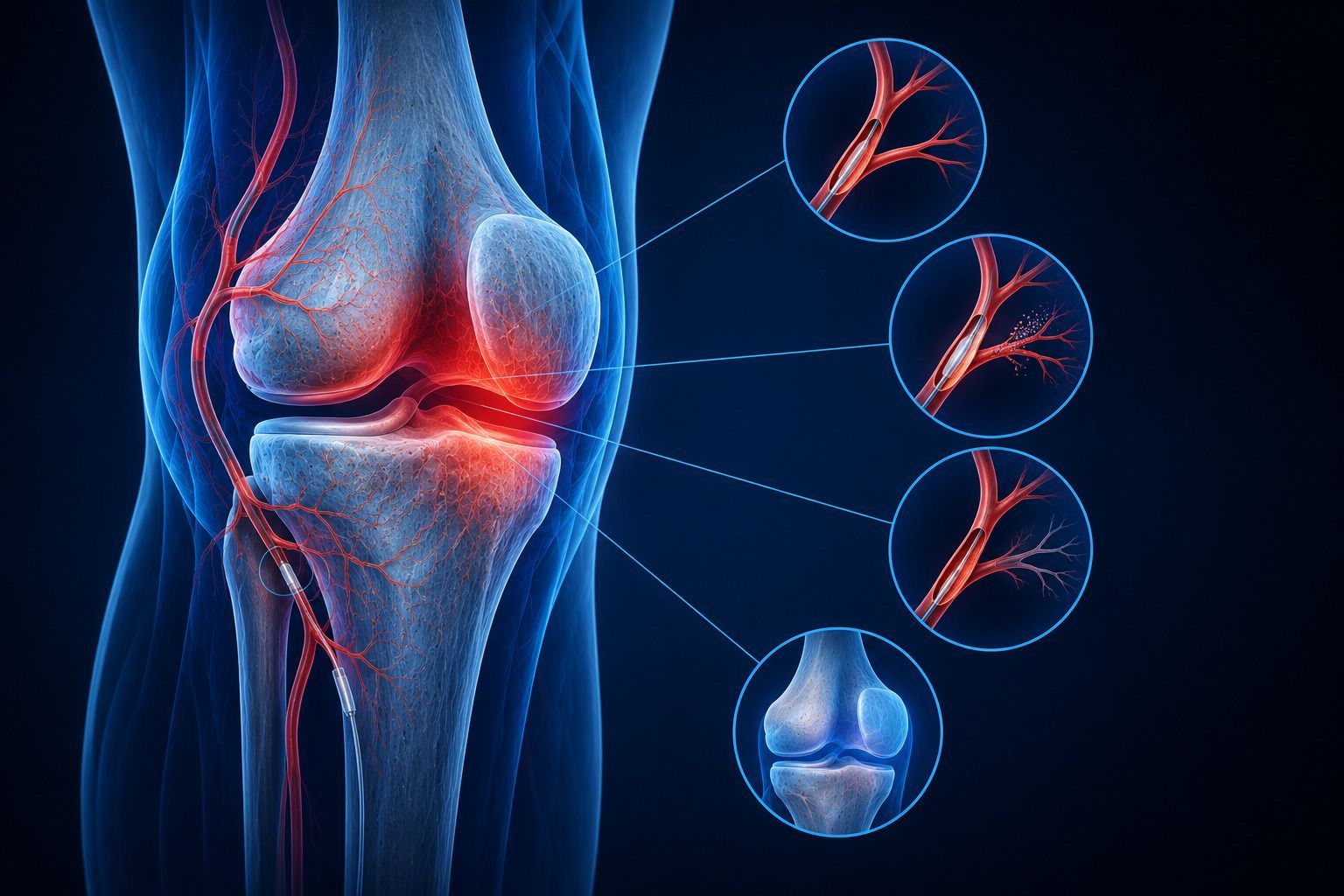
When your knee has arthritis, something unusual happens inside the joint: your body grows new, abnormal tiny blood vessels in the lining of the knee (called the synovium) in response to the inflammation. These new vessels are not normal — they carry inflammatory chemicals directly into the joint, which is a major driver of chronic knee pain.
GAE works by blocking those abnormal vessels using microscopic particles delivered through a thin tube (catheter). Once blocked, the inflammatory cycle is interrupted — and pain decreases significantly for most patients.
The full medical term — Genicular Artery Embolization — breaks down like this:
- Genicular
— refers to the genicular arteries, the blood vessels that supply the knee joint
- Artery
— the blood vessel being treated
- Embolization
— the process of blocking a blood vessel using tiny particles injected through a catheter
The procedure was originally developed to stop bleeding after knee surgery. Doctors noticed that patients who underwent embolization also reported significantly less arthritis pain — which led to dedicated research into GAE as a pain treatment. Multiple peer-reviewed studies
have since confirmed its effectiveness for knee osteoarthritis.
Why does knee arthritis hurt so much?
Understanding why knee arthritis is so painful helps explain why GAE works so well.
Osteoarthritis (OA) is often described as "wear and tear" — cartilage breaking down over time. But the pain of knee OA is not just from cartilage loss. It is also driven by chronic inflammation in the joint lining(the synovium). When the synovium becomes inflamed, it swells, produces fluid, and sends pain signals through the nerves surrounding the knee.
In response to this inflammation, your body grows new blood vessels to try to "heal" the area. But these abnormal vessels — called neovessels
— actually make things worse. They carry inflammatory chemicals deeper into the joint and sensitize the nerves, making even ordinary movements painful.
This is the cycle GAE breaks. By selectively blocking these abnormal vessels, the inflammatory environment inside the knee is reduced — and with it, the pain.
The inflammation cycle — and how GAE breaks it
2
Joint lining becomes inflamed
3
Abnormal vessels grow, feeding inflammation
4
Nerves sensitize — chronic pain sets in
GAE blocks step 3 — interrupting the entire cycle
What actually happens during a GAE procedure?
Many patients feel nervous about anything involving a catheter or blood vessels. The reality is that GAE is much simpler and more comfortable than it sounds. Here is a step-by-step walkthrough of what you can expect.
1
Before the procedure — preparation
You will have a consultation with your SEVA Healthcare specialist to review your X-rays or MRI, confirm your diagnosis, and determine whether GAE is appropriate for your level of arthritis. You may be asked to avoid blood-thinning medications for a few days beforehand. No general anesthesia is required — you will be awake but relaxed with local anesthesia and mild sedation.
2
A small puncture — not a cut
Your doctor makes a tiny puncture — smaller than a pencil tip — in the skin near your wrist or groin to access an artery. A thin, flexible tube called a catheter is guided through your blood vessels toward the knee using real-time X-ray imaging (fluoroscopy). You will not feel the catheter moving inside you.
3
Mapping the abnormal vessels
A contrast dye is injected through the catheter so your doctor can see the blood vessels in your knee on the X-ray screen. The abnormal vessels — the ones causing inflammation — appear as a bright "blush" in areas that correspond exactly to where your knee hurts. This precision mapping ensures only the problem vessels are treated.
4
The embolization — blocking the vessels
Tiny microspheres — particles about the width of a human hair — are injected through the catheter directly into the abnormal vessels. These particles are permanent and biocompatible (safe for your body). They lodge in the vessel walls and block blood flow to the inflammatory tissue. The abnormal vessels gradually shrink, and the inflammatory environment in the joint begins to resolve.
5
After the procedure — recovery
The entire procedure typically takes 45 to 90 minutes. You will rest for a short observation period — usually 2 to 4 hours — before going home the same day. Most patients return to light activity within 1 to 3 days. You may notice some mild soreness or skin redness around the knee in the first week — this is a normal response to the treatment and resolves on its own.
What does the clinical evidence say?
GAE has been studied extensively over the last decade. Here is what the research shows — explained clearly.
99.7%
Technical success rate
Across 9 studies and 270 patients, GAE was successfully completed in virtually every case. Source: PMC meta-analysis, 2023
47–85%
Patients with sustained relief at 2 years
Multiple 24-month studies show durable pain reduction in most patients treated for mild-to-moderate OA. Source: JVIR, 2024
50%+
Average pain score reduction
Pain scores (VAS) dropped from an average of 66.5 at baseline to 14.0 at 2 years — a greater than 50% reduction. Source: Cardiovascular and Interventional Radiology
5.2%
Proceeded to knee replacement at 2 years
Only 5.2% of GAE patients needed total knee replacement within 2 years — meaning the vast majority avoided surgery. Source: PMC meta-analysis, 2023
An honest note from our team
GAE is most effective for patients with mild-to-moderate knee osteoarthritis. Evidence for severe OA is more limited and results may not be as durable. A 2026 review in the journal Expert Review of Clinical Immunology
noted that while single-arm studies consistently show significant improvements, some placebo-controlled trials suggest a component of nonspecific effects. At SEVA Healthcare, we will always give you an honest assessment of whether GAE is likely to help your specific situation — and if it is not the right fit, we will recommend something that is.
Who is GAE right for?
GAE tends to work best for patients who meet most of these criteria:
- Diagnosed with mild-to-moderate knee osteoarthritis(Kellgren-Lawrence grade 2–3)
- Experiencing persistent knee pain despite trying conservative treatments — physical therapy, weight management, anti-inflammatory medications, or cortisone injections
- Not ready for — or not eligible for — total knee replacement surgery
- Pain that corresponds to specific areas of the knee (inner, outer, or front)
- No severe joint space narrowing or bone-on-bone arthritis throughout the entire joint
- No active infection, blood clotting disorders, or allergy to contrast dye
Our specialists at Lewisville, Rowlett, and South Tulsa
will review your imaging and history carefully to confirm whether you are a good candidate. If GAE is not appropriate, we will discuss alternatives including PRP therapy, genicular nerve blocks, or radiofrequency ablation.
"
I was scheduled for a knee replacement. My surgeon told me it was the only option left. A friend told me about GAE at SEVA Healthcare. I went from barely being able to walk my dog to hiking again — without surgery. It has been 14 months and I am still doing great.
SEVA Healthcare patient — Dallas, TX
★★★★★
What results can you realistically expect?
Results vary by individual and by severity of arthritis — but here is a realistic picture based on the clinical evidence:
Mild soreness and possibly some skin redness near the knee. This is normal. Most patients feel little difference in pain yet — the treatment is still taking effect.
Many patients begin noticing reduced pain and improved mobility. Swelling in the knee often decreases during this period.
Most patients experience their best results during this window. Significant pain reduction and improved function in daily activities — walking, stairs, sleep.
Studies show 47–85% of patients maintain meaningful pain relief at 2 years. Some patients benefit from a repeat procedure if symptoms return. Only 5.2% needed knee replacement within 2 years.
How does GAE compare to other knee pain treatments?
| Treatment |
How long it lasts |
Recovery |
Best for |
| Cortisone injection |
4–12 weeks |
Same day |
Short-term flare relief |
| PRP therapy |
6–18 months |
1–3 days |
Mild-moderate OA, tissue repair |
| GAE ← you are here |
12–24+ months |
1–3 days |
Mild-moderate OA, avoid surgery |
| Genicular nerve RFA |
9–18 months |
1–2 days |
Moderate-severe OA pain |
| Knee replacement |
15–20+ years |
3–6 months |
Severe OA, all else failed |
Frequently asked questions about GAE
Is GAE painful?
The procedure is performed under local anesthesia with mild sedation — most patients describe it as very tolerable and feel little discomfort during the procedure itself. Afterward, some mild knee soreness and skin redness is normal for the first week.
How long does the procedure take?
The procedure itself takes 45 to 90 minutes. You will spend an additional 2 to 4 hours in recovery before going home the same day. Most patients are back to light activity within 1 to 3 days.
Does GAE work if I have bone-on-bone arthritis?
The clinical evidence for GAE is strongest for mild-to-moderate osteoarthritis. For severe or bone-on-bone OA throughout the entire joint, results are less predictable. Your SEVA specialist will review your imaging and give you an honest assessment. In some severe cases, we may recommend other approaches first.
Can I have GAE and still get a knee replacement later if needed?
Yes — GAE does not prevent or complicate future knee replacement surgery. Many patients use GAE to delay surgery by months or years, and if they ultimately do need a replacement, the procedure proceeds normally. At 2 years follow-up in published studies, only 5.2% of GAE patients proceeded to knee replacement.
Is GAE covered by insurance?
Insurance coverage for GAE varies and is evolving as the evidence base grows. SEVA Healthcare's team will verify your specific coverage before your consultation. We will always be transparent about costs and explore every coverage option available to you.
Can both knees be treated at the same time?
In some cases, both knees can be treated in the same session. Your specialist will evaluate whether this is appropriate based on your overall health and the extent of arthritis in each knee.
Where can I get GAE in Dallas or Tulsa?
SEVA Healthcare offers GAE at our clinics in Lewisville, Rowlett, and South Tulsa. Same-week consultations are available for new patients.
Related articles from SEVA Healthcare
Take the next step
Find out if GAE is right for your knee pain
Same-week consultations available at our Dallas and Tulsa clinics. Our specialists will review your imaging and give you an honest assessment — no pressure, no unnecessary procedures.
TX: (214) 306-4116 · OK: (918) 935-3240 · sevahealthcare.com
This article is written for informational and educational purposes and does not constitute medical advice. Clinical data referenced from peer-reviewed sources including the Journal of Vascular and Interventional Radiology (2024), PubMed meta-analysis (2023), CardioVascular and Interventional Radiology, and Expert Review of Clinical Immunology (2026). Individual results vary. GAE is most effective for mild-to-moderate osteoarthritis. Please consult a board-certified pain management specialist to determine whether GAE or any other treatment is appropriate for your specific condition.